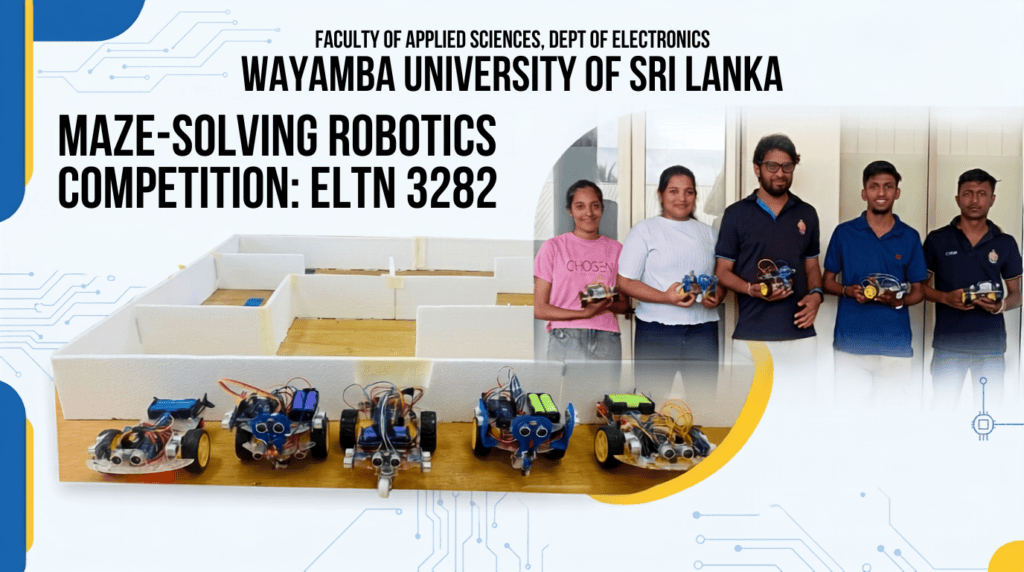
The Department of Electronics, Faculty of Applied Sciences, Wayamba University of Sri Lanka, successfully organized a Robotics Competition on 28 July 2026 at the Electronics Laboratory as the final project demonstration for the ELTN 3282 – Mechatronics course.
The competition challenged student teams to design, fabricate, and program an autonomous maze-solving robot capable of navigating a 4 × 4 grid. The objective of the challenge was to start the robot from one corner cell of the maze and autonomously navigate through the grid to reach the diagonally opposite corner in the shortest possible time while maintaining accurate path planning and navigation. The activity was designed to provide students with hands-on experience in applying mechatronics principles while strengthening their technical knowledge, creativity, teamwork, and problem-solving skills.
The participating robots were designed and developed entirely by students who successfully completed the course. Each team integrated mechanical, electronic, and software components to produce a fully functional autonomous robotic system. The robots incorporated a range of electronic modules, including ultrasonic distance measuring sensors, infrared (IR) reflectance sensors, DC gear motors, motor driver modules, microcontrollers, and other supporting electronic components to detect walls, determine their position within the maze, and make intelligent navigation decisions.
A total of five competitive robots participated in the event, each demonstrating a unique engineering design and navigation strategy. The robots were evaluated based on design quality, technological implementation, time taken to complete the maze, and grid-solving accuracy. The competition witnessed an impressive level of innovation and technical excellence, with the best-performing robot successfully completing the challenge in 59 seconds.
The competition was judged by Mr. P. G. T. R. Payagala, Lecturer (Probationary), Department of Electronics, and Ms. H. M. S. Mihihansi, Lecturer (Probationary), Department of Electronics. The judges commented the students for their innovative designs, effective integration of hardware and software, and their ability to transform theoretical concepts into practical engineering solutions. Constructive feedback was also provided to encourage further improvements in robotic system design and autonomous control.
The Robotics Competition served as an excellent platform for experiential learning, enabling students to bridge the gap between theory and practice through the complete engineering design process—from concept development and hardware integration to programming, testing, and performance evaluation. The Department of Electronics remains committed to promoting project-based learning initiatives that cultivate innovation, technical competence, and teamwork, preparing graduates to meet the demands of the rapidly evolving fields of robotics, automation, and intelligent systems.